
If you haven’t read the theory part on how to choose a niche for a website, spend 5 minutes and read it first.
In this part we’ll get to practice and briefly go through how to quickly analyze and evaluate the niche you’ve chosen.
We’ll need 10 site ideas, which you should put together based on the theory part and your own experience.
Since we care about income, let’s “google” the top most expensive clicks, and we land on an article from Serpstat about the most expensive keywords in the USA and Canada.
After reading through it all, I picked out the following topics. From the same list you may pick different ones:
- Legal services
- Insurance
- Business finance and credit
- Medicine and pharmacy
- Software development and outsourcing
- Cloud servers and hosting
- Business software
- Online advertising
- IP telephony and call centers
- Military careers and training
Competition and profitability
Since these topics come from the list of the most expensive keywords, they all have maximum profitability and competition.
You can pick any topic from the list above.
Required level of expertise
Cross out the niches we know little about and don’t want to learn. Keep 1-2 topics.
Size
The topics on the list are already broad. To be more effective, let’s narrow the niches down.
If the topic is Insurance, we can limit ourselves to one of the subtopics: car insurance, home insurance, insurance comparisons, useful articles about insurance. Or we can narrow the niche even further, focusing only on car insurance in one specific state.
Estimating potential traffic
In search, take the top 5 competitor sites for the query “car insurance”, then enter the competitors’ sites into similarweb and see how much traffic they get per month. If you’re happy with it, move on. If not, broaden the query. This is a quick way to analyze traffic. For an accurate and complete analysis, you need to put together a list of the queries you plan to rank for and calculate the traffic across all of them.
Seasonality
As described in the first article, check for seasonality in Google Trends.
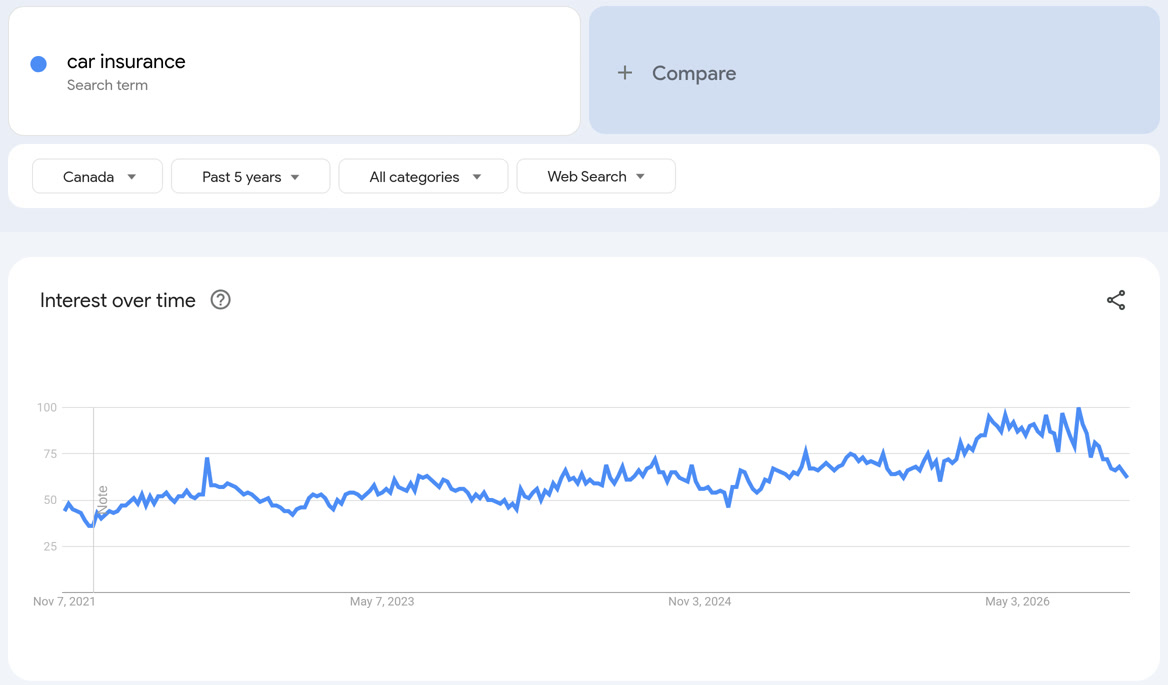
We can see that there’s no repeating yearly pattern, so seasonality is weak. If that’s not the case in your topic, either change the topic or think ahead about whether you can cover the traffic dips with a related topic, to keep traffic even all year.
Commercial potential
Insurance monetizes well, it’s one of the most expensive topics on the list, from insurance company ads to affiliate programs. What can you sell on your site? If you can’t think of anything, better change the topic.
Once you’ve chosen the topic correctly, you can start coming up with a name for the project and planning the site’s content. We’ll talk about that in the next articles.